
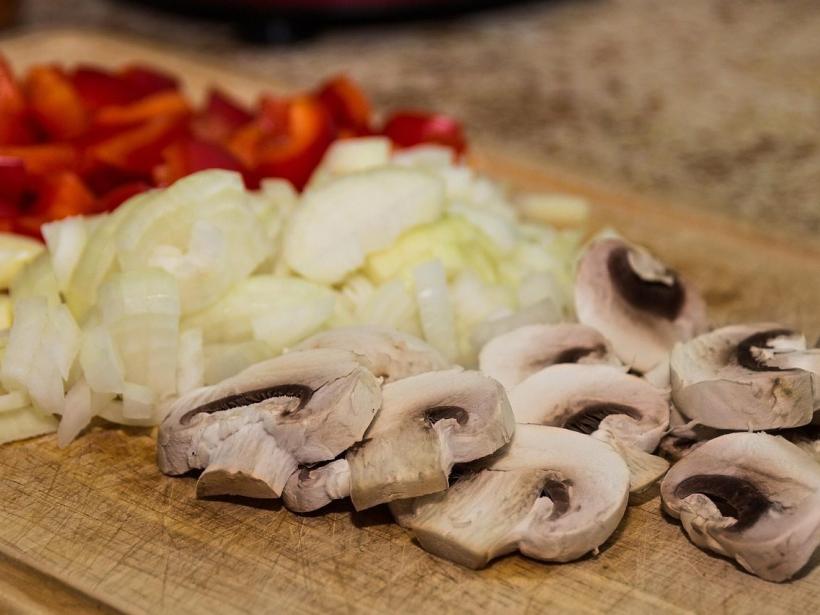
Why do even cuts matter for a salad?
Even pieces catch dressing at the same rate, so no single bite drowns in vinaigrette while another stays dry. A consistent dice or slice also means every forkful delivers the intended mix of flavors instead of a mouthful of one ingredient.
When a salad includes roasted vegetables, uniform size keeps the cooking predictable. A thin shard of carrot blackens before a thick chunk softens. Cutting to the same thickness fixes that timing issue before the pan ever gets hot.
The look matters too. A bowl of ragged, mismatched pieces looks like leftovers. Clean, repeatable cuts show care and make even a simple green salad look deliberate. That tidiness also helps when you build composed salads, where ingredients sit in distinct sections on a platter rather than tossed together.
What knife and board do you need?

Even cuts start with a sharp chef’s knife and a board that stays put. A dull blade crushes vegetable fibers instead of slicing them cleanly, leaving ragged edges. A sharp 8-inch chef’s knife gives you the weight and length to push straight down through a carrot or a bell pepper without sawing back and forth.
Place a damp kitchen towel flat under your cutting board and press the board down. The towel grips the counter and the board at the same time, so nothing slides while you work. A heavy wooden board is ideal because it absorbs the impact and keeps the knife edge sharp longer than glass or plastic.
Keep a small paring knife nearby for detail work like trimming stems or cutting cherry tomatoes in half. The short blade gives you more control when the vegetable is too small to hold safely under a chef’s knife. Three tools cover almost every salad task:
- A sharp 8-inch chef’s knife for bulk cutting and even slices.
- A sturdy wooden or bamboo cutting board that sits flat on the counter.
- A damp kitchen towel tucked under the board to stop it from shifting.
- A 3- or 4-inch paring knife for small vegetables and trimming.
- A honing steel to realign the edge of the chef’s knife before you start.
How do you dice a vegetable into even cubes?
Dicing into perfect cubes starts with creating flat, stable surfaces. A round carrot or zucchini rocks on the board, so your first cut is always a thin lengthwise slice to create a flat bottom. Lay the vegetable on that flat side and it sits steady while you work.
Cut the vegetable lengthwise into slabs of your desired cube thickness, typically a quarter to half an inch. Stack a couple of slabs, then slice them lengthwise again into sticks as wide as the slabs. Gather the sticks into a tight bundle, curl your fingertips under on your guide hand so your knuckles face the blade, and slice crosswise into cubes. Keep the knife tip on the board and rock the blade down and forward, matching each cut to the width of the sticks for true cubes.
- Trim a thin slice off one side so the vegetable lies flat on the board.
- Slice the vegetable lengthwise into even slabs.
- Stack slabs and cut lengthwise into sticks of equal thickness.
- Gather sticks, tuck fingertips under, and cut crosswise into cubes.
- Check the first few cubes against each other and adjust your spacing as needed.
How do you cut a vegetable into thin julienne strips?

Julienne cuts, those tidy matchstick strips, start with a stable plank. Square off the vegetable by trimming a thin slice from one long side to create a flat base. Place that flat side down on the board so it does not rock. For a carrot or zucchini, cut the piece crosswise into 2-inch (5 cm) segments first; they are easier to control than a whole vegetable.
Slice each segment lengthwise into planks of the thickness you want for the final strip. Stack a few planks, keeping the edges aligned, then slice through the stack to create strips of the same width. The stack method gives you several strips with one pass and keeps their size uniform.
- Trim a flat side first for a stable base.
- Cut crosswise into 2-inch (5 cm) segments.
- Slice lengthwise into planks of even thickness.
- Stack a few planks with edges flush.
- Slice through the stack to form matchstick strips.
How do you slice vegetables into rounds or half-moons of the same thickness?

Slicing into rounds starts with a stable vegetable. Trim off both ends so you have a flat surface to work with. For long vegetables like cucumbers or zucchini, cut them in half crosswise first. A shorter piece is easier to control and keeps every slice consistent from the first cut to the last.
Use the claw grip to protect your fingertips. Curl your fingers inward and press the vegetable against the board with your knuckles. Rest the side of the knife blade against those knuckles as you slice. Move your guiding hand back a fraction of an inch after each cut. Your knuckles set the thickness, not your eyes, so the slices come out the same every time.
For half-moons, cut the vegetable in half lengthwise before you start slicing. A cucumber works best if you split it right down the middle and place the flat side against the board. The vegetable will not roll, and your knife stays steady. Keep the same claw grip and knuckle guide, and you will get a pile of neat, even half-moons ready for the bowl.
What is the best order to cut vegetables for a salad?
Start with the cleanest, driest ingredients and work toward the messier ones. Cutting sturdy vegetables like carrots and celery first keeps your board clear for delicate herbs and leafy greens later. This sequence also prevents strong flavors from transferring to mild ingredients before they hit the bowl.
- Wash and thoroughly dry all vegetables before you pick up the knife. Excess water on the board makes cuts slippery and uneven.
- Cut sturdy, dry vegetables first. Carrots, radishes, celery and bell peppers leave minimal residue and give you a clean surface for the next item.
- Move to juicy vegetables next. Tomatoes and cucumbers release liquid, so cutting them after the firm stuff keeps the board manageable.
- Slice mild alliums like red onion or shallot now. Their flavor stays on the board briefly and wipes away with one pass of a towel.
- Chop fresh herbs last. Parsley, cilantro and dill bruise under heavy ingredients, and a clean board preserves their bright color and aroma.
Wipe the board with a dry paper towel between categories when switching from juicy produce to herbs. If you cut a pungent ingredient like raw garlic early, its oil clings to the surface and will coat every leaf of basil that follows. A quick wipe removes that oil and resets the workspace. This habit adds maybe ninety seconds to your prep and keeps every component tasting like itself.
Frequently asked questions
Do I need a mandoline to get even slices?
A mandoline helps but is not required. With a sharp chef's knife and the claw grip you can slice just as evenly. If you do use a mandoline, always use the hand guard and go slowly.
My knife keeps slipping on the skin. What should I do?
Start by cutting a thin flat spot on one side of the vegetable so it sits steady on the board. A damp paper towel under your cutting board also stops the whole board from sliding.
How small should salad vegetable pieces be?
Aim for bite-size pieces, roughly half an inch to three-quarters of an inch. The goal is a forkful that holds several ingredients together without needing to be cut again on the plate.
Can I prep the vegetables ahead of time?
Yes. Cut vegetables keep well in an airtight container in the fridge for up to two days. Store hard vegetables like carrots and peppers separately from softer ones like tomatoes so they stay crisp.
Photo: niekverlaan, Pixabay (Pixabay Content License)