
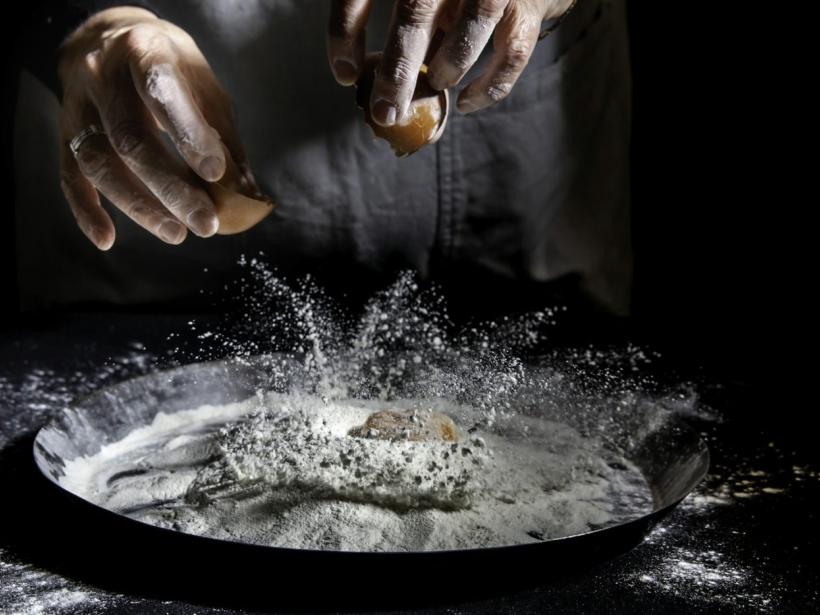
What is an omelette poulard and how is it different from a regular omelet?
An omelette poulard is a dramatically tall, soufflé-like omelet created by whipping egg whites and yolks separately before folding them together and finishing the dish in a hot oven. The technique traces back to Annette Poulard, who began serving it to pilgrims at her inn on Mont Saint-Michel in the late 1800s. Her version became so famous that the inn, La Mère Poulard, still draws visitors who watch cooks beat eggs with long whisks in copper bowls over an open fire.
The structure sets it apart from a classic French omelet. A regular omelet is made from whole eggs whisked together and cooked gently in a buttered pan until just set. It is tender, flat or lightly rolled. An omelette poulard separates the eggs entirely: the whites get whipped to stiff peaks, the yolks are seasoned and beaten until pale, and the two are folded together with careful, deliberate strokes. This trapped air expands in the oven, creating a puffed, golden cylinder that stands several inches tall on the plate.
What ingredients do I need for an omelette poulard?

An omelette poulard needs just a few pantry staples. Their quality and temperature matter more than anything else. Cold eggs will not whip to the same volume, and the wrong butter can burn before the eggs set.
For two generous servings, gather these ingredients before you start. Measure everything and bring it to room temperature before you heat the pan.
- 4 large eggs, at room temperature, separated into yolks and whites
- 2 tablespoons unsalted butter, divided (1 tbsp for the pan, 1 tbsp cold for the finish)
- 1/4 teaspoon fine sea salt, plus a pinch for the whites
- 1 tablespoon finely chopped fresh chives or chervil (optional)
- 2 tablespoons finely grated Gruyère or Comté cheese (optional)
What equipment makes the biggest difference?
You need a heavy, oven-safe nonstick skillet above all else. You need a pan that can move from the stovetop into a hot oven without hesitation, and a reliable nonstick surface lets the puffed eggs release cleanly onto the plate. An 8-inch or 10-inch pan works well for the classic four-egg omelette poulard.
A stand mixer or a powerful hand mixer creates the towering, soufflé-like height. Whisking by hand will not incorporate enough air to achieve the signature lift. A stand mixer with the whisk attachment lets you whip the whites to stiff peaks while the yolks are beaten separately, which is the traditional method.
You will also need a wide, flexible silicone spatula. You will use it to gently fold the whipped whites into the yolk base without deflating them, to spread the mixture evenly in the pan, and to loosen the edges before sliding the finished omelette out. A stiff wooden spoon or a thin metal spatula knocks the air out and leaves you with a flat, dense result.
How do I whip and fold the eggs for maximum height?

Start with eggs straight from the counter, not the fridge. Cold whites refuse to trap air, so let them sit out for 20 minutes before you crack a single shell. Separate three large eggs one at a time into two clean bowls, catching every yolk whole. A single drop of yolk in the whites will stop them from whipping up, so crack each egg over a small cup first and transfer the white only when you are sure it is clean.
Whip the whites with a balloon whisk or an electric mixer on medium speed until they hold a stiff peak that stands straight up when you lift the beater. Stop the moment you reach that point. Overwhipped whites turn grainy and weep liquid, and they will collapse the second you fold them. Beat the yolks with a pinch of salt until they are smooth and slightly paler, about thirty seconds.
Slide the yolks onto the whites and fold with the lightest touch you have. Cut straight down through the center with a wide silicone spatula, scrape along the bottom of the bowl, and lift the whites up and over the yolks. Turn the bowl a quarter turn and repeat. Stop after eight to ten strokes, while a few white streaks still show. Those streaks finish mixing in the hot pan, and folding until uniform knocks out the air you worked to build.
What is the exact cooking method, step by step?
Set an oven rack in the middle position and preheat the broiler to 500°F (260°C). You need intense top-down heat the moment the omelette leaves the stovetop. Place a 10-inch nonstick oven-safe skillet over medium-low heat and add 2 tablespoons of unsalted butter. Let the butter melt slowly and foam without browning. Tilt the pan to coat the bottom and sides completely.
Pour the whipped egg mixture into the center of the pan in one steady stream. Do not stir or shake the pan. Let the eggs set undisturbed for 60 to 90 seconds, until you see a pale golden rim form around the edge while the center still jiggles when you gently nudge the handle. The bottom should be set but not deeply colored.
Immediately transfer the skillet to the broiler, placing it 6 to 8 inches from the heating element. Broil for 2 to 3 minutes, watching through the oven window. Pull the omelette when the top is dry to the touch, domed and deeply puffed, with a light brown crust. Do not open the oven door during the first 2 minutes, as the trapped steam is what drives the rise.
How do I know when the omelette is done?

You are looking for a deeply golden, souffléd top with edges that have pulled away from the skillet by about a quarter of an inch. The surface should be dry to the touch and spring back lightly when pressed with a fingertip, not leave a sticky film. You want a slight jiggle in the very center. That last bit of wobble means the interior is still molten and creamy, and it will finish setting from carryover heat after you slide it onto the plate.
An instant-read thermometer removes the guesswork. Slide the probe into the thickest part of the puff, avoiding the bottom of the pan. A reading between 165°F and 170°F (74°C to 77°C) tells you the eggs are fully set but not dry. If the omelette has stopped jiggling entirely and the top feels firm, it is already overdone and will be spongy rather than cloud-like. Take it off the heat the moment it hits that temperature window.
What are the most common mistakes that ruin an omelette poulard?
A few small missteps can collapse all that hard-earned air. The most frequent problem is overbeating the whites. Stop while they still form soft, droopy peaks; stiff peaks make the foam brittle and it will break when you fold in the yolks.
Temperature control is just as important. A cold pan causes the eggs to stick and cook unevenly, so always preheat your skillet over medium-low heat for a full two minutes before adding butter. Skip any butter with water added. Whipped or low-fat butter introduces steam that deflates the delicate structure. Stick with a high-fat European-style butter.
- Overbeating the egg whites. Whisk only to soft peaks that flop over when you lift the whisk. Stiff peaks create a dry foam that cannot stretch as the omelette rises and will crack during baking.
- Starting with a cold pan. The butter should foam gently the moment it hits the metal. If the pan is not hot enough, the bottom layer sets too slowly and the air bubbles escape before a crust forms.
- Opening the oven door early. The puff depends on steady, dry heat. A blast of cool air in the first ten minutes causes the omelette to sink instantly. Use the oven light and look through the glass instead.
- Using the wrong butter. Butter with a high water content, including most whipped or standard supermarket sticks, releases steam that weighs down the eggs. Clarified butter or a European-style butter with at least 82% butterfat gives a cleaner puff.
- Deflating the yolks during folding. Stir the yolks into the whites with a light hand and a wide silicone spatula. Aggressive stirring knocks out the air you just whipped in, leaving a dense, flat result.
- Skipping the rest after baking. The omelette continues to set from residual heat. Cutting into it right out of the oven lets steam escape too fast and the center may collapse. Let it sit for one minute before serving.
Frequently asked questions
Can I make an omelette poulard without an oven?
Yes, you can finish it on the stovetop with a tight-fitting lid. Keep the heat low and resist lifting the lid for at least 8 minutes. The result will be slightly denser but still puffy.
What fillings work best in an omelette poulard?
Stick to light, finely grated additions like Gruyère, fresh chives, or tarragon. Heavy fillings such as sautéed mushrooms weigh down the structure, so scatter them on top after baking instead.
How do I store and reheat leftovers?
An omelette poulard is best eaten right away. If you have leftovers, refrigerate them in an airtight container for up to one day and reheat gently in a 300°F oven for 5 to 6 minutes. The texture will soften.
Can I use a non-dairy butter substitute?
You can use a high-quality plant-based butter, but choose one with a high fat content for proper browning. Avoid spreads with a lot of water, as they create steam and prevent a crisp crust.
Photo: John Legrand, Unsplash (Unsplash License)